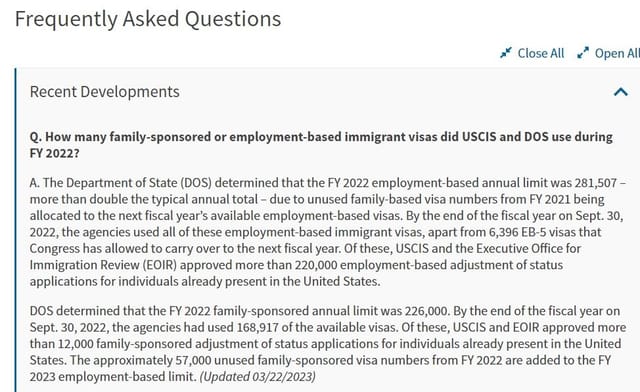
Do you know something about the EB3 visa process?
Of course, I can provide you with information about the EB-3 visa process. The EB-3 visa is a type of employment-based immigrant visa in the United States that is designed for skilled workers, professionals, and other workers with less advanced qualifications. It's part of the employment-based preference category within the U.S. immigration system.
There are three subcategories within the EB-3 visa category:
-
EB-3A: Professionals: This subcategory is for individuals with a bachelor's degree or its foreign equivalent, and a job offer in a profession that requires at least a bachelor's degree.
-
EB-3B: Skilled Workers: This subcategory is for individuals with at least two years of job experience or training, and a job offer for a position that requires at least two years of experience or training.
-
EB-3C: Other Workers: This subcategory is for individuals with less than two years of experience or training, and a job offer for a position that requires less than two years of experience or training.
The general process for obtaining an EB-3 visa involves the following steps:
-
Labor Certification: Before an employer can sponsor a foreign worker for an EB-3 visa, they typically need to obtain a labor certification from the U.S. Department of Labor (DOL). This involves demonstrating that there are no qualified U.S. workers available for the position and that hiring a foreign worker will not adversely affect the wages and working conditions of U.S. workers in similar jobs.
-
Job Offer: An employer must offer a job to the foreign worker in one of the EB-3 subcategories (A, B, or C), and the job offer should meet the specific requirements for that subcategory.
-
Form I-140 Petition: Once the labor certification is approved, the employer files Form I-140, Immigrant Petition for Alien Worker, with U.S. Citizenship and Immigration Services (USCIS). This form establishes the foreign worker's eligibility for the EB-3 visa and provides details about the job offer and the labor certification.
-
Priority Date: The filing date of the Form I-140 establishes the foreign worker's priority date, which is important for tracking their place in line for visa processing. Visa numbers for the EB-3 category are subject to annual limits.
-
Visa Bulletin: The U.S. Department of State publishes a Visa Bulletin each month that indicates the current visa numbers available for various visa categories, including EB-3. Your priority date needs to be earlier than the listed date in the Visa Bulletin to move forward in the process.
-
Adjustment of Status or Consular Processing: Depending on the foreign worker's location, they will either apply for adjustment of status if they are already in the U.S., or they will apply for an immigrant visa through consular processing if they are outside the U.S.
-
Medical Examination and Background Checks: As part of the visa application process, the foreign worker will need to undergo a medical examination and background checks.
-
Visa Interview and Approval: If applying through consular processing, the foreign worker will attend a visa interview at the U.S. embassy or consulate. If the visa is approved, they can enter the U.S. as an EB-3 immigrant.
It's important to note that the EB-3 visa process can be complex and time-consuming, and it's recommended to consult with an immigration attorney or legal expert to navigate the process effectively. Additionally, visa availability and processing times can vary based on factors such as the foreign worker's country of origin and the demand for EB-3 visas in that category.